By Matheus Americano, Alexandre Sawaya, Gabriel Dias and Fernando Dias
Poor-quality software costs $2.41 trillion per year worldwide, while investing in quality yields a return of 3 to 5 times the amount invested;
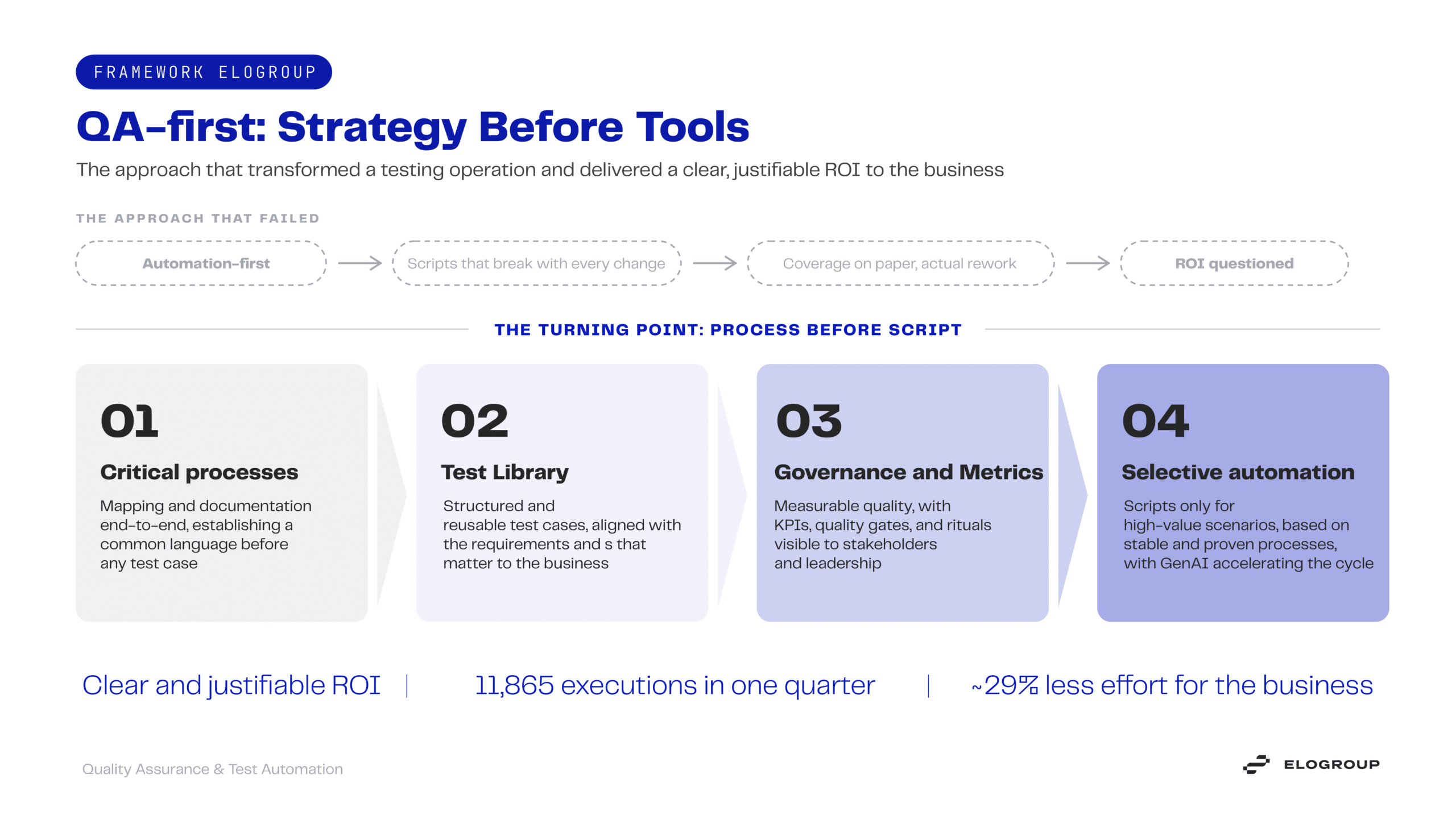
Automating first and thinking later fails: for a real client, the “automation-first” strategy led to rework and an ROI that was difficult to justify, until the shift to “QA-first”;
By prioritizing process over scripting, the operation reached 11,865 executions in a single quarter and reduced the business’s effort on the Tax Reform by ~29%.
From end-of-line to business driver
For decades, testing was left until the very end of the process, carried out only after the code was already finished and the deadline was looming. This reactive approach is costly, as poor-quality software costs the world approximately $2.41 trillion annually, according to CISQ. In an agile context, the problem is exacerbated because 68% of organizations still fail to integrate quality into development, according to Capgemini’s World Quality Report 2024-25.
Those who treat quality as an investment—rather than an expense—reap clear returns. In addition to a 3- to 5-fold return on investment, correcting a design flaw costs 5 to 10 times less than fixing it in production, and high-performing teams have a failure rate for changes that is 7 times lower, according to DORA. Add to this brand protection—which is crucial given that 75% of consumers avoid companies after software failures—and quality ceases to be a cost center and becomes a competitive advantage. It was precisely this turning point that EloGroup facilitated for a multinational agribusiness company with a large-scale SAP operation, whose journey forms the basis of this article.
Why starting with the tool is the most costly mistake
Why Starting with the Tool Is a Mistake This client’s story began like so many others: automate first, think later. The result was predictable. The scripts broke with every system change, and the team spent more time restoring automation than generating value. Worse, they automated what was easy to write, not what was critical to the business, so defects kept making their way into production, and sponsors began to question the ROI. Coverage existed on paper, but no one knew for sure what was actually protected.
The course correction was to adopt a QA-first model—and the sequence matters. First came the mapping and documentation of critical end-to-end processes, giving the team a common language before writing any test cases. Next was the construction of a structured, reusable test library aligned with the requirements. Next came governance and metrics, which made quality measurable for stakeholders. Only then, based on stable and proven processes, was automation introduced selectively, targeting high-value scenarios, and the ROI became clear and defensible. Ultimately, the lesson is simple to state but difficult to put into practice: strategy defines the what and the why—the objectives, risks, and scope—before any discussion of the how, which is the tool. The tool is an implementation detail; strategy is the roadmap.
There is a technical reason behind this initial failure, and it has a name. By pursuing coverage at any cost, the operation inflated the most fragile and expensive layer of any suite—the interface tests—which break with every minor visual change and require more maintenance than they deliver. A mature strategy follows the logic of the automation pyramid: a broad base of fast, stable unit- and API-level tests, and a lean set of interface tests, reserved for truly critical workflows. The goal shifts from covering everything to covering what matters—with stability. When the balance tips and interface tests dominate, a red flag is raised—usually at the expense of budget and credibility.
This framework reflects the pillars that underpin any mature quality transformation. Shift-Left Testing brings quality forward to the requirements definition phase and has reduced correction costs by 60% at companies such as Google and Spotify. Quality Gates create mandatory checkpoints; Risk-Based Testing prioritizes effort based on the probability and impact of failure; and Shared Quality distributes responsibility among developers, Product Owners, and operations. Automation builds on this foundation, not in place of it: the solution combines the robust, open-source Selenium WebDriver with keyword-based low-code interfaces, which allow QAs and POs to set up tests without writing code, while GenAI takes it to the next level by validating requirements, generating test cases, and producing scripts integrated with Jira, GitHub, and CI/CD pipelines.
Tailored quality: why there is no one-size-fits-all model
Rebuilding the operation did not mean imposing an off-the-shelf model. Trying to apply the same rigid process to every project is the surest way to turn quality into bureaucracy. EloGroup starts with a defined and mature set of practices, but tailors which procedures, deliverables, and gates apply to each initiative based on its context. This approach to tailored quality—tailoring—strikes a balance between flexibility and governance: the process is comprehensive and standardized as a reference, yet adapted to the risk, size, criticality, and maturity of each project and team.
Operational models follow the same logic of adaptation: the centralized model ensures standardization and governance, but can become a bottleneck; the decentralized model improves product quality, at the cost of inconsistency among squads; the hybrid model strikes a balance between the two. For this client, the operation combined all three approaches based on maturity, with a decentralized process within the squads for discovery, a centralized hub for delivery, and a cross-functional governance layer overseeing adoption, KPIs, and communities of practice.
Maturity frameworks such as TMMi and CMMI serve as a reference to guide tailoring, not as a mandatory path. At the start of the journey in 2026, the client was at the early maturity levels, structuring the process and demonstrating value through pilot projects, with a clear plan for evolution toward predictive, data-driven QA. Adopting this structured maturity approach reduces the total cost of quality by 40% to 60%.
Results in practice
With a process-first approach, the metrics shifted from focusing on the number of tests to speaking the language of business. The operation scaled consistently and sustainably over the course of six sprints per quarter.

The business highlight came from the Tax Reform: by leading the execution of the tests, QA reduced the workload of the business areas by approximately 29%, covering 269 scenarios and nearly 2,000 test steps. At the same time, the volume of test runs grew from 9,749 in 2025 to 11,865 in the first quarter of 2026—a sign of robust execution capacity and expanding coverage, not wasted effort.
This principle of focusing on value has already yielded measurable results. In 2025, by taking the lead in executing tests related to the Tax Reform, the quality assurance team reduced the workload on the client’s business units by approximately 29%, allowing them to redirect that time to tasks that truly require human judgment. The ambition for 2026 goes even further, as the goal is to increase automated coverage to 100% of test scenarios and, in doing so, completely free the business from manual execution, consolidating automation as a cogs in the machine that runs in the background while people focus on decision-making.
This maturity was also evident in the ability to detect defects earlier. A total of 155 defects were identified in Q1 2026, most of which were detected before reaching production, supported by a library of 2,065 test cases, 248 test plans, and 81 end-to-end business flows. During an SAP Service Pack upgrade, 77 automated scenarios ran with an 85% pass rate and anticipated critical blockers, directly informing the Go/No-Go decision with evidence rather than intuition.
What isn’t measured can’t be improved
None of this is sustainable without measurement. From an engineering perspective, the DORA metrics define the elite tier, with lead times under one day, on-demand deployments, a failure rate for changes below 15%, and recovery in less than one hour. From an executive perspective, KPIs such as test coverage, defect density, automation percentage, and cost avoided translate quality into business terms. On the client side, these indicators came to life in a sprint-based QA Journal, custom fields in Jira, and a dedicated dashboard, with checkpoint rituals that kept leadership engaged in the adoption of the new model. A RACI matrix closed the loop by assigning roles and making shared quality an explicit commitment.
MATHEUS AMERICANO is a partner at EloGroup.
ALEXANDRE SWAYA, GABRIEL DIAS e FERNANDO DIAS are from EloGroup.