By André Franco
Why AI literacy programs fail when treated as a course, and what sets organizations that capture value apart from those stuck in PoCs
- The bottleneck for AI in large organizations is not technological, but organizational. According to Gartner, 61% of AI leaders feel pressure to accelerate, but only 17% of companies have the maturity to sustain the momentum.
- AI literacy is not a training course. It is the corporate infrastructure that underpins the entire AI strategy and shapes what we call the “Supercollaborator.”
- Programs that focus solely on everyday AI (day-to-day assistants) or solely on transformational AI (large-scale projects) remain stuck within a single perspective and fail to unlock systemic value.
- AI-first does not mean people-last. The organizations that are extracting real value from AI are precisely those that have placed people at the center of their strategy.
The pressure is widespread, maturity is rare, and the Global Business Services (GBS) experiences this paradox to the extreme. It has all the ingredients to capture value with Artificial Intelligence, thanks to its high volume of transactions, critical processes, and end-to-end data. Yet it remains stuck in proof-of-concept phases that fail to scale. The problem rarely lies in the technology chosen. It lies in failing to understand what is holding back your organization’s AI adoption journey and focusing on the right capabilities given your level of maturity.
The bottleneck in AI is not technological; it is organizational
Investment in AI is growing every quarter, but organizations’ ability to turn that investment into results is not keeping pace. The 2026 Gartner AI Maturity Survey shows that 61% of AI leaders feel pressured by their executive committees to move forward with AI initiatives before they are ready. Among IT leaders, 57% report that this pressure comes from business leaders. And only 17% of the organizations surveyed by Gartner score highly on the dimensions necessary to sustain a long-term journey: strategy, data, governance, literacy, engineering, organization, portfolio, and value.
At the GBS, this tension is clearly evident. The department deals with high volumes, repetitive tasks, and structured data—exactly what generative AI promises to amplify. But the pitfall is twofold: either projects never move beyond the proof-of-concept stage, or the return on investment (ROI) is slow to materialize, stifled by operations that haven’t been reimagined in light of the new technology.
Ascenty, a data center operator with a presence in Brazil, Chile, and Mexico, experienced this paradox. When it structured its AI program, the first strategic decision was not to treat AI as an IT project. The company understood that AI is an important tool when used as a transformation of the operational model that would need to cut across all departments of the company.
The mistake of treating literacy as training
The most common reaction to the push for AI is to set up a training program. Invite a specialized company, open up classes, certify employees in the use of Copilot, Claude, or ChatGPT, and declare victory. The problem is simple: a course doesn’t change behavior, and literacy only creates value if it changes behavior.
The concept needs to be redefined. AI literacy programs are, first and foremost, corporate infrastructure. They bring together the set of conditions that enable employees to operate within a new work paradigm, in which they shift from executing tasks to orchestrating them.
This infrastructure has three layers that must work together:
- Targeted audience:What a CFO needs to understand about AI is radically different from what an analyst who will be managing the order-to-cash process needs to know. One-size-fits-all programs fail because they treat different roles with the same content.
- Purpose tied to pain points: Theory doesn’t engage; pain points do. When employees bring the real-world problems from their own areas into the training, engagement reaches a whole new level. Teaching people how to use a tool without anchoring it to a relevant problem leads to phantom adoption.
- Customized format with diverse learning experiences: training tracks must combine expository content, case studies, test-and-learn approaches, and active learning, balanced according to the audience’s profile and the required technical depth.
Successful programs treat literacy as one of the six interdependent capabilities of an AI strategy—along with positioning, analytical foundations, organization and working methods, value delivery, and governance. When literacy is isolated as a training initiative, it loses its connection to the strategy and becomes noise.
Investing in people is the AI strategy with the highest proven return, especially for organizations that are still building their analytical capabilities. Gartner quantifies this difference: during the stage when the foundation is being laid, Data & AI Literacy programs account for a 43% difference in financial performance between organizations that invest the most and those that invest the least in this area.
The Two Faces of AI
There are two distinct types of AI coexisting in companies today, and most programs address only one of them.
Routine AI involves the individual use of assistants like Copilot, ChatGPT, or Claude to achieve marginal productivity gains. It reduces task completion time, improves first drafts of documents, and speeds up analyses. It’s important because it builds proficiency: employees learn the technology’s limitations and discover where it helps and where it hinders. But the gains are incremental.
Transformational AI is different. These are projects that rethink an entire process—an agent that responds to complex Requests for Proposal (RFPs), an inventory optimization model, or an automated account reconciliation system. This is where most of the tangible return lies. And this is usually what self-funds the organization’s AI program.
The classic mistake is to focus on only one of these horizons. Companies that bet solely on everyday AI end up with more productive employees, but without real business transformation. Companies that bet solely on transformational AI deliver large, isolated projects, but without fluency at the grassroots level. The adoption of each new project becomes a cultural battle that starts from scratch.
A well-structured literacy program connects the two. It empowers employees to move between them: to use everyday AI in their daily work, to recognize when a recurring pain point warrants a transformational project, and to actively participate in building solutions within their domain. Everyday AI builds fluency, transformational AI creates impact, and the literacy infrastructure serves as the bridge between the two.
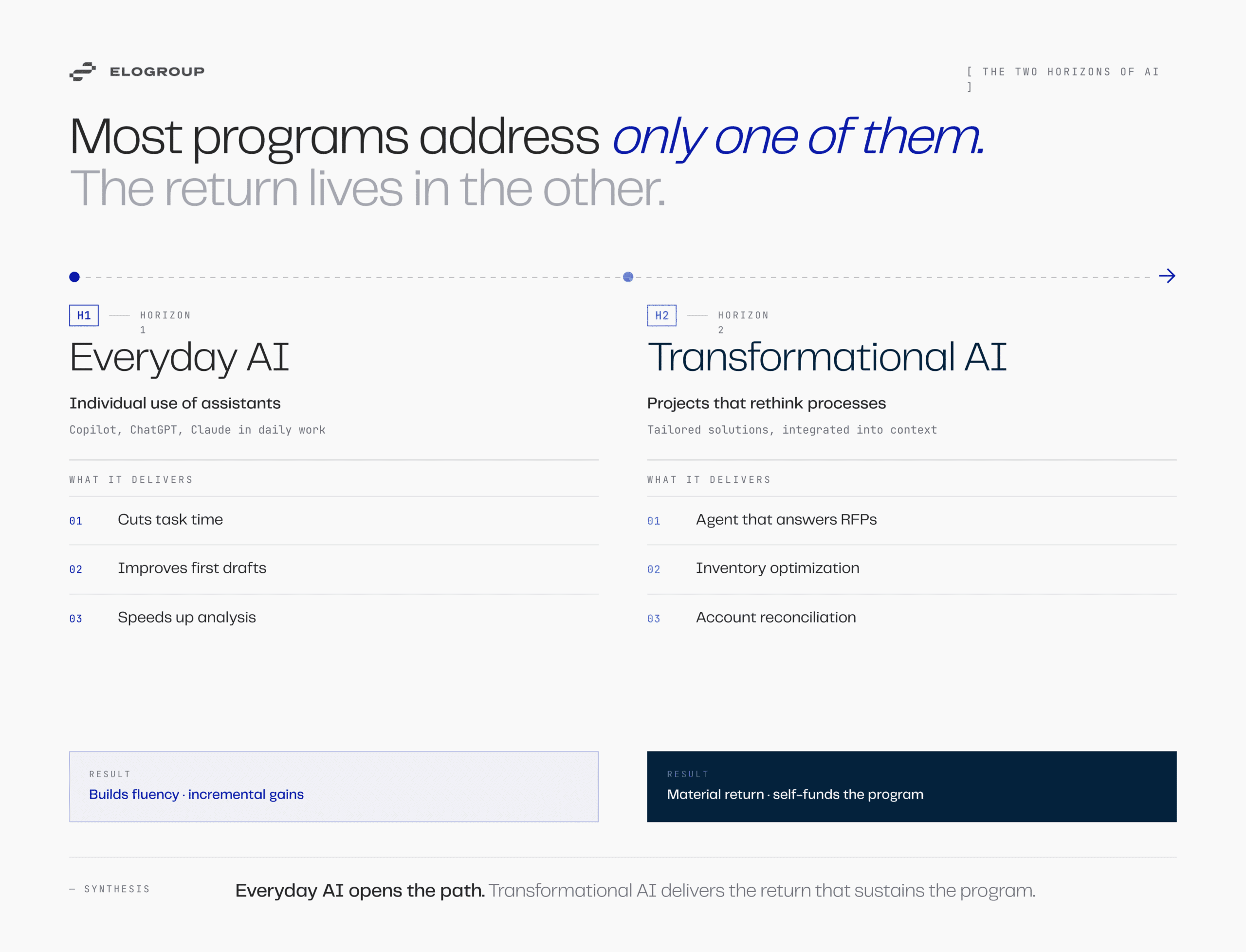
In Ascenty’s journey, this combination is clearly evident. Solutions like Fala Aí Ascenty (a conversational assistant available to all employees) pave the way for everyday AI. The RFP Assistant, meanwhile—which reduced response times for complex commercial proposals from eight hours to 30 minutes—is pure transformational AI: it has redesigned a critical business process.
The destination of well-executed AI is the Super Employee
There is a recurring fear in large organizations: if AI automates tasks, what will be left for employees? In the Contact Center (CSC), where operations involve repetitive activities, this fear is even more acute.
This fear stems from a mistaken premise. As Gartner points out, “AI-first does not mean people last.” Digital-native companies, which were born with AI at their core, did not put people last. They started with employees actively engaged in AI to transform products and processes. The transformed company is not the one that replaced people with models; it is the one that created a new type of employee.
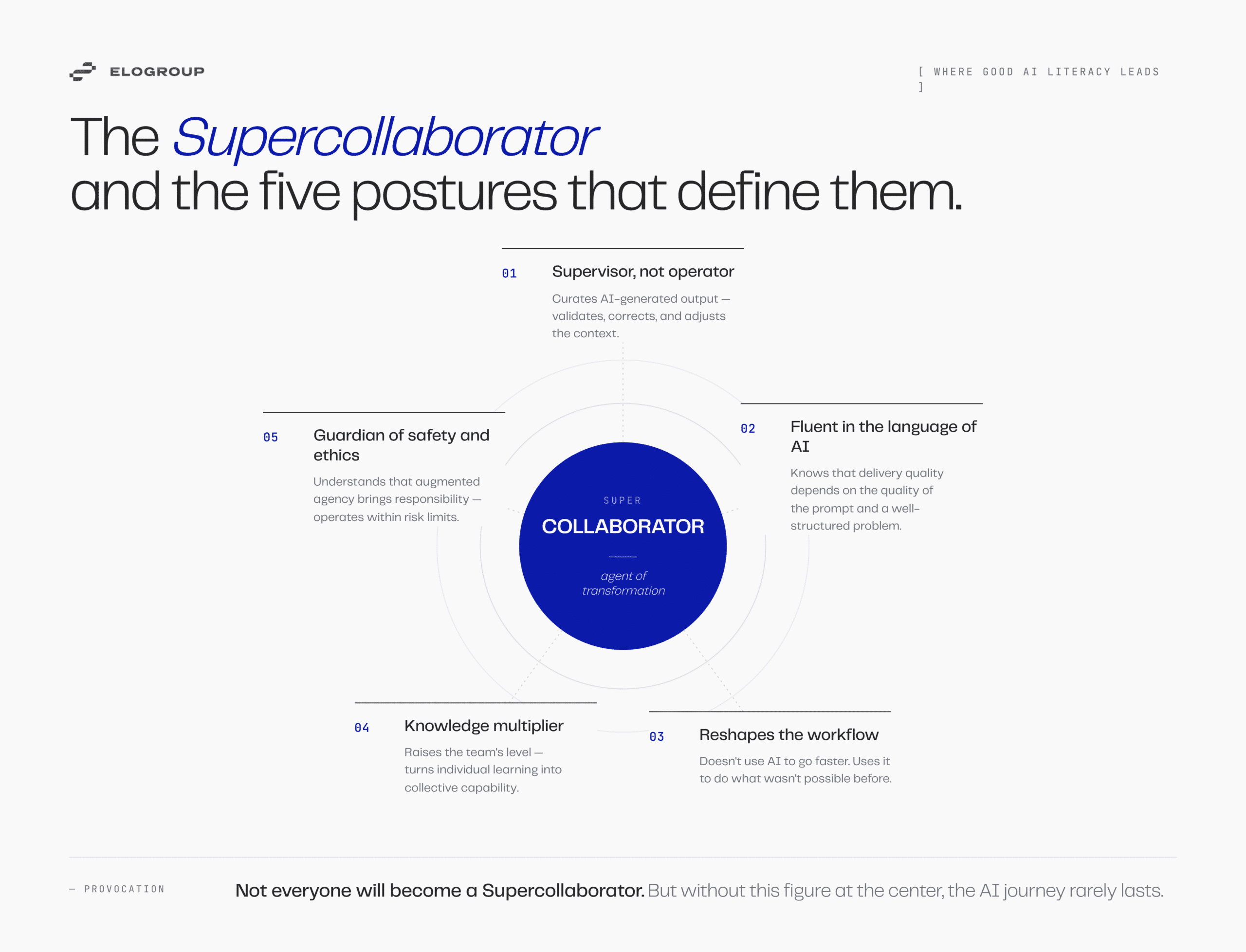
This profile is known as the Super Employee. It is not someone who is more productive simply because they master a tool. It is a professional who adopts five new mindsets:
Supervisor, not just an operator: acts as a curator of the results generated by AI, validating, correcting, and adjusting the context.
- Fluent in the language of AI: knows that the quality of the output depends on the quality of the prompt and how the problem is framed.
- Transforms their workflow: doesn’t use AI to do what they already did faster. Uses it to do what they couldn’t do before.
- Knowledge multiplier: raises the team’s level by sharing what they learn, transforming individual learning into collective capability.
- Guardian of security and ethics: understands that augmented agency brings responsibilities and operates within the organization’s risk limits.
Not all employees will become Supercollaborators. In an organization of 5,000 people, having a few agents of transformation across different functional domains makes the journey possible. But without this figure at the center of the strategy, a company is unlikely to achieve a sustainable AI journey.
What This Means for the GBS
The CSC that will unlock value with AI in the next wave isn’t the one with the best model or the one that’s adopted the best tool. It’s the one that has managed to integrate three elements into a cohesive framework: people’s behavior, the operational model, and institutional knowledge.
Behavior, because without Supercollaborators, there’s no one to orchestrate the process. Operational model, because a process designed for an older way of thinking fails to capture value from the new one. Knowledge, because institutionalizing what is learned is what enables scaling—by transforming each success story into a reusable asset.
Companies that treat Literacy as infrastructure—and not as training—build this cognitive structure. Those that treat Literacy as a course buy the illusion of progress, but not the result.
Ascenty’s journey, with more than 15 months of a structured program, illustrates this path. The decision to combine massive cultural dissemination with selected transformational initiatives—supported by visible leadership sponsorship and adaptive governance—is the kind of architecture that enables AI to evolve from a one-off project into an institutional capability.
Talk to our experts about AI Literacy and AI strategy for GBS.
ANDRÉ FRANCO is a Partner at EloGroup